
The Hidden Science Behind Great Runners: What Recreational Athletes Can Learn from Sebastian Sawe
There is a moment during every long run when the body begins to negotiate with the mind.
The legs start becoming heavy. The breathing rhythm changes slightly. The shoulders rise without notice. Foot contact becomes louder. The pelvis begins to lose control. What started as a smooth, effortless stride slowly transforms into survival.
Most recreational runners think fatigue is simply about fitness.
But in reality, fatigue is often a movement problem long before it becomes a cardiovascular problem.
When elite marathon runners like Sebastian Sawe run, they are not merely producing speed. They are managing movement efficiency at an extraordinary level. Every step becomes a conversation between the nervous system, muscles, tendons, breathing mechanics, posture, and ground reaction forces. Their performance is not only built in the heart and lungs. It is built through mechanical precision.
At Sports2Science, this is exactly where we believe the future of running performance exists.
Most runners are taught to train harder. Very few are taught to move better.
This difference changes everything.
When we analyzed the running mechanics of Sebastian Sawe, one thing became immediately clear. His movement was not “perfect” in the traditional sense many people imagine. Instead, it was highly optimized for energy conservation, force transfer, rhythm, and fatigue resistance. That distinction matters because many runners spend years trying to “look” like elite runners without understanding why elite runners move the way they do.
A recreational runner may focus only on pace, cadence, or mileage. But underneath every run, there are deeper physiological events happening continuously. The pelvis stabilizes the trunk. The core manages rotational control. The foot absorbs and redistributes forces. The breathing system influences trunk stiffness and rhythm. The nervous system coordinates timing with incredible precision. When one area begins to fail, another area compensates.
That compensation is where injuries often begin.
Sometimes it starts subtly.
A slightly collapsing knee during stance phase. A delayed glute activation. Excessive pelvic drop. Overstriding during fatigue. Increased vertical oscillation. Reduced arm swing coordination. Many runners continue training through these changes because pain has not appeared yet. But movement inefficiency accumulates silently before symptoms emerge.
This is why two runners can have the same VO2 max, similar endurance, and similar weekly mileage, yet perform completely differently.
Movement efficiency changes the cost of running.
Elite runners are masters at reducing unnecessary energy leaks. Research in biomechanics and running economy consistently shows that even small improvements in mechanical efficiency can dramatically influence endurance performance over long distances.
The fascinating part is that elite movement principles are not reserved only for world-class athletes.
That is one of the biggest misconceptions in modern running culture.
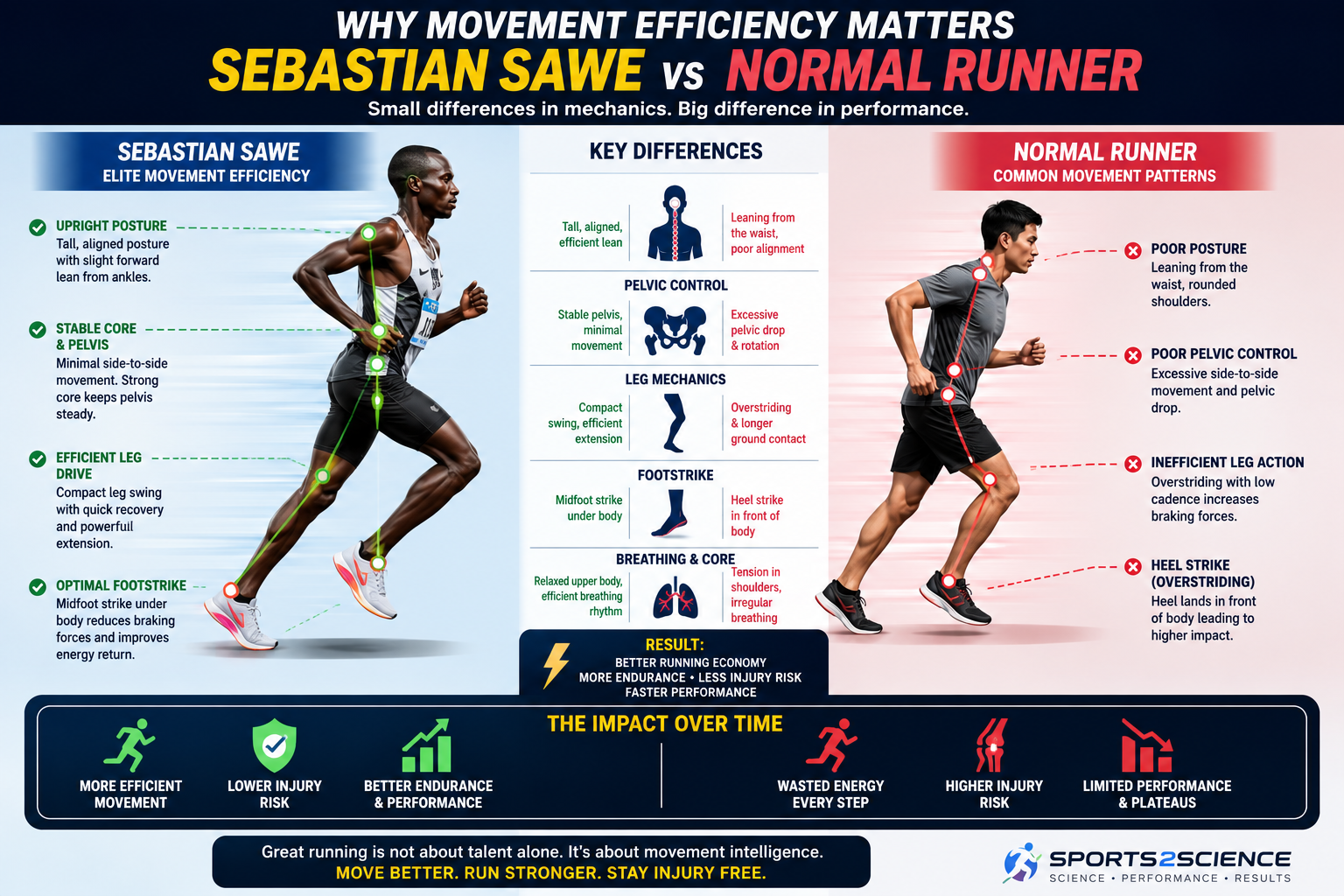
A recreational runner preparing for a 5K in Chennai faces the same fundamental biomechanical laws as an elite marathoner competing internationally. The speed differs. The physiological capacity differs. But the human body still obeys the same movement principles. Pelvic control still matters. Ground force management still matters. Breathing mechanics still matter. Postural control still matters.
This is why running gait analysis is becoming increasingly important across all levels of sport and fitness.
At Sports2Science, we often see runners who believe their issue is lack of endurance when the actual limitation is inefficient mechanics. Some runners lose enormous energy because of poor trunk control. Others overload the calf excessively because hip stability is compromised. Some runners develop recurring knee pain not because the knee itself is weak, but because the entire kinetic chain above it is poorly coordinated.
The body never moves in isolation.
Everything is connected.
What makes runners like Sebastian Sawe extraordinary is not simply their fitness level. It is the integration between physiology and mechanics. Their nervous system learns to maintain efficient movement patterns even under extreme fatigue. Their stride does not collapse emotionally or mechanically when the body becomes stressed.
That level of efficiency is not built overnight.
It is trained.
And this is where modern sports science becomes powerful.
Today, technology allows us to understand movement with remarkable detail. Motion capture systems, biomechanics analysis, force profiling, muscle activation studies, and movement assessments can reveal hidden inefficiencies that the naked eye may completely miss. The goal is not to force every runner into a robotic movement pattern. The goal is to help each runner discover their most sustainable, efficient, and resilient movement strategy.
Because ultimately, great running is not only about speed.
It is about sustainability.
The runners who stay injury-free for years are usually not the ones who train the hardest every single day. They are often the runners whose bodies distribute stress more intelligently. Their movement systems recover better. Their mechanics tolerate load better. Their nervous system adapts better.
This becomes even more important as modern lifestyles continue reducing natural movement exposure. Many runners today spend long hours sitting before attempting high training loads. The body loses variability, mobility, and neuromuscular coordination. Running then becomes not only a fitness activity, but also a diagnostic window into how the human body functions under stress.
That is why movement science is no longer relevant only for elite sport.
It is becoming essential for everyday health and long-term performance.
The future of running may not belong solely to those who train harder.
It may belong to those who understand movement deeper.
And perhaps that is the real lesson behind watching runners like Sebastian Sawe. Beyond the medals, records, and headlines lies something more important: a reminder that human performance is not accidental. It is engineered through thousands of coordinated biological events happening every second.
Every footstrike tells a story.
Every stride reveals a system.
And every runner, whether elite or recreational, has the ability to move better, perform better, and understand their body at a completely new level.
“If you are a runner looking to improve running mechanics, reduce injury risk, enhance pelvic control, or undergo professional running gait analysis and performance assessment in Chennai, connect with Sports2Science for advanced biomechanics-driven running analysis, movement assessment, and endurance performance optimization.”
Check out our Blog on Elite Running Mechanics Analysis of Sebastian Sawe: Biomechanical Insights from Sports2Science Chennai
Disclaimer
This article is intended purely for educational and awareness purposes. The observations regarding Sebastian Sawe are based on publicly visible movement analysis and sports science interpretation. This content should not be considered medical diagnosis or individualized training prescription. Individual biomechanics, physiology, injury history, and training requirements vary significantly from person to person.
Running biomechanics, running gait analysis, Sebastian Sawe running form, running mechanics, pelvic control running, running injury prevention, sports science running, running economy, endurance biomechanics, marathon running analysis, Sports2Science Chennai