
The Intelligence Hidden Inside Human Movement
Why Exercise Was Never Just About Muscles
A child takes its first step and the entire family celebrates. Phones come out. Smiles appear. Someone claps loudly from the corner of the room while another quietly wipes tears from their eyes. To most people, it feels like a beautiful milestone — a simple moment every human eventually reaches.
But hidden underneath that tiny step is one of the most sophisticated neurological achievements in human existence.
Long before the child stood upright, the nervous system had already spent months studying gravity. Thousands of invisible corrections had already occurred between the brain, eyes, inner ear, joints, muscles, and environment. The child had already fallen repeatedly, adjusted repeatedly, failed repeatedly, and tried again without even understanding what “trying again” meant. Millions of neurons were slowly organizing themselves into something humans eventually call movement.
Most people never think about this miracle again.
Athletes spend their entire lives rediscovering it.
For decades, the world has viewed exercise through muscles. Fitness became associated with visible strength, body shape, aesthetics, and performance outputs people could easily measure from the outside. Stronger muscles became the symbol of health. Bigger muscles became the symbol of discipline. Faster muscles became the symbol of athleticism.
But underneath every movement humans have ever performed lies something far more intelligent.
Your muscles never decided to move.
Your nervous system did.
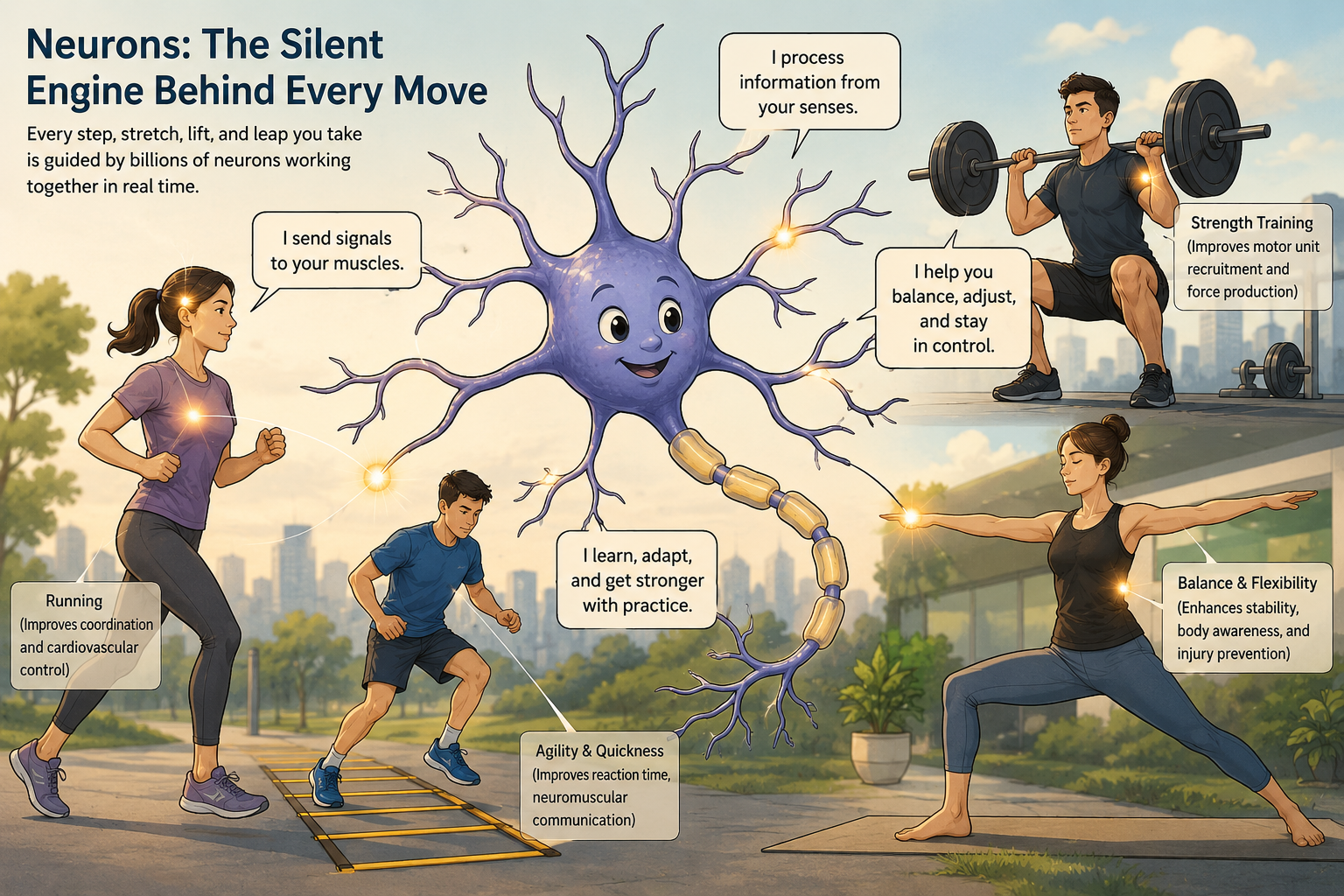
Every sprint begins as electricity. Every jump begins as prediction. Every reaction begins before conscious awareness fully catches up. Before the body moves, the nervous system has already started calculating balance, danger, force, timing, and coordination. What humans experience externally as movement is actually the visible expression of billions of invisible neurological conversations happening continuously inside the body.
This changes the meaning of exercise entirely.
Perhaps exercise was never simply about training the body. Perhaps it has always been one of the deepest ways humans train the nervous system itself.
Watch an elite athlete closely and something unusual becomes obvious. The greatest performers often look calmer than everyone else. Time almost appears slower around them. A badminton player reacts to a smash before the audience fully understands what happened. A football player adjusts body position milliseconds before contact. A gymnast rotates through the air with astonishing precision while making movements appear effortless.
To spectators, this often looks like talent.
But what humans call talent is frequently the nervous system becoming extraordinarily efficient at solving movement problems.
The elite athlete is not simply stronger.
The elite athlete is neurologically refined.
The nervous system learns through repetition. Every practice session leaves fingerprints on the brain. Every repeated movement strengthens neural pathways. Every correction teaches the nervous system something about timing, stability, efficiency, and survival. Slowly, movements that once demanded enormous conscious effort become automatic. This process is known scientifically as neuroplasticity, but even that word feels too small for what is truly happening. Human beings are physically rewiring themselves through movement experiences.
This is why elite athletes often describe entering a “flow state.” The body no longer feels separate from movement. Reactions emerge almost instinctively. The athlete is no longer consciously calculating every action because the nervous system already embedded the solution deeply through years of adaptation.
And yet, the same nervous system capable of producing brilliance can also produce limitation.
An athlete who looked fluid during practice may suddenly tighten under pressure. Rhythm disappears. Timing collapses. Simple skills suddenly feel difficult. Spectators often call this nervousness or choking, but underneath the experience something biological is occurring. Stress physically changes movement. Anxiety changes muscle activation. Fear changes coordination. Under pressure, the nervous system shifts priorities toward protection and survival rather than performance optimization.
The muscles did not suddenly forget the skill.
The nervous system changed the output.
This may also explain why fatigue is far more complex than people imagine. Most individuals think fatigue begins in muscles, but the nervous system often begins struggling much earlier. An exhausted athlete does not merely lose strength. Reaction timing slows. Balance subtly changes. Coordination becomes inconsistent. Tiny landing mechanics shift. Decision-making deteriorates by fractions that become enormously important in sports.
The crowd sees clumsiness.
The nervous system sees overload.
Sometimes injuries occur not because the muscles are incapable, but because the nervous system is attempting to protect the body under excessive stress.
Perhaps one of the most overlooked realities in rehabilitation science is that injuries do not only damage tissues. Injuries also affect trust.
When humans experience pain, the nervous system remembers it. Even after physical healing improves, movement may still feel threatening to the brain. Protective movement patterns emerge automatically. Confidence disappears. Coordination changes. Fear quietly alters movement behavior without the individual fully realizing it.
This is why rehabilitation is often much deeper than rebuilding muscle strength.
Rehabilitation frequently becomes the process of teaching the nervous system that movement is safe again.
A runner returning after injury is not only rebuilding tissue.
They are rebuilding neurological confidence.
Modern neuroscience increasingly reveals that movement influences far more than fitness. Exercise appears deeply connected to cognition, emotional regulation, attention, learning, resilience, and mental clarity. The brain itself seems to thrive under movement exposure. Perhaps this should not surprise us. Human beings evolved through movement-rich environments for thousands of years. Walking, climbing, balancing, reacting, throwing, and exploring helped shape the nervous system humans still carry today.
Modern life, however, has quietly disconnected many humans from this biological reality.
The human nervous system evolved expecting movement variability, yet modern environments increasingly reduce movement from daily life. Humans now spend enormous portions of life seated, screen-focused, cognitively overloaded, and physically under-stimulated. Yet the nervous system still craves movement because movement helped build the human brain itself.
Perhaps this explains why movement restores something people struggle to describe emotionally. A walk after emotional stress feels relieving for a reason. Exercise improves mental clarity for a reason. Children instinctively move constantly for a reason. Athletes describe feeling truly alive during movement for a reason.
Movement is not merely calorie expenditure.
Movement is biological communication.
Every movement teaches the nervous system something. The way humans sit teaches it something. The way humans train teaches it something. The way humans recover teaches it something. The way humans respond to stress teaches it something. The nervous system is constantly listening to experience and reshaping itself around it.
The future of sports science may therefore move far beyond muscles alone. The next generation of human performance may increasingly revolve around understanding reaction systems, motor learning, neural efficiency, sensory integration, movement intelligence, and neuro-mechanics. The athlete of the future may not simply become physically stronger, but neurologically sharper, emotionally adaptable, and more efficient at processing information under pressure.
Because the human body was never merely mechanical.
It was always electrical. Predictive. Adaptive. Intelligent.
And perhaps the most beautiful realization hidden inside exercise science is this:
Muscles may move the body.
But neurons create movement.
At Sports2Science, movement is viewed not merely as exercise, but as information. Inside human movement are hidden neurological, biomechanical, and physiological signals that may help explain performance, fatigue, injury risk, recovery, coordination, and adaptation. Whether working with athletes, runners, rehabilitation populations, corporates, or the general community, the goal is not simply to improve movement quantity.
The goal is to improve movement intelligence.