The Global Sitting Pandemic Nobody Is Talking About
How Modern Convenience, Work-From-Home Culture, and Reduced Movement Are Quietly Reshaping Human Health
Introduction: A National Conversation That Opened a Bigger Question
In May 2026, Indian Prime Minister Narendra Modi urged citizens to reduce fuel consumption, use public transport more often, consider work-from-home practices again, and adopt more responsible lifestyle habits amid global energy uncertainty and rising fuel pressures. (The Economic Times)
His suggestions included:
- Working from home where possible
- Using metro and public transport
- Carpooling
- Increasing electric vehicle usage
- Reducing unnecessary travel
- Encouraging virtual meetings
- Reducing excessive consumption patterns
The conversation was largely centered around fuel conservation and economic resilience. But beneath these discussions lies a much deeper and global issue that very few are talking about:
Humans are moving less than ever before
And the consequences are becoming one of the biggest silent health crises of modern civilization.
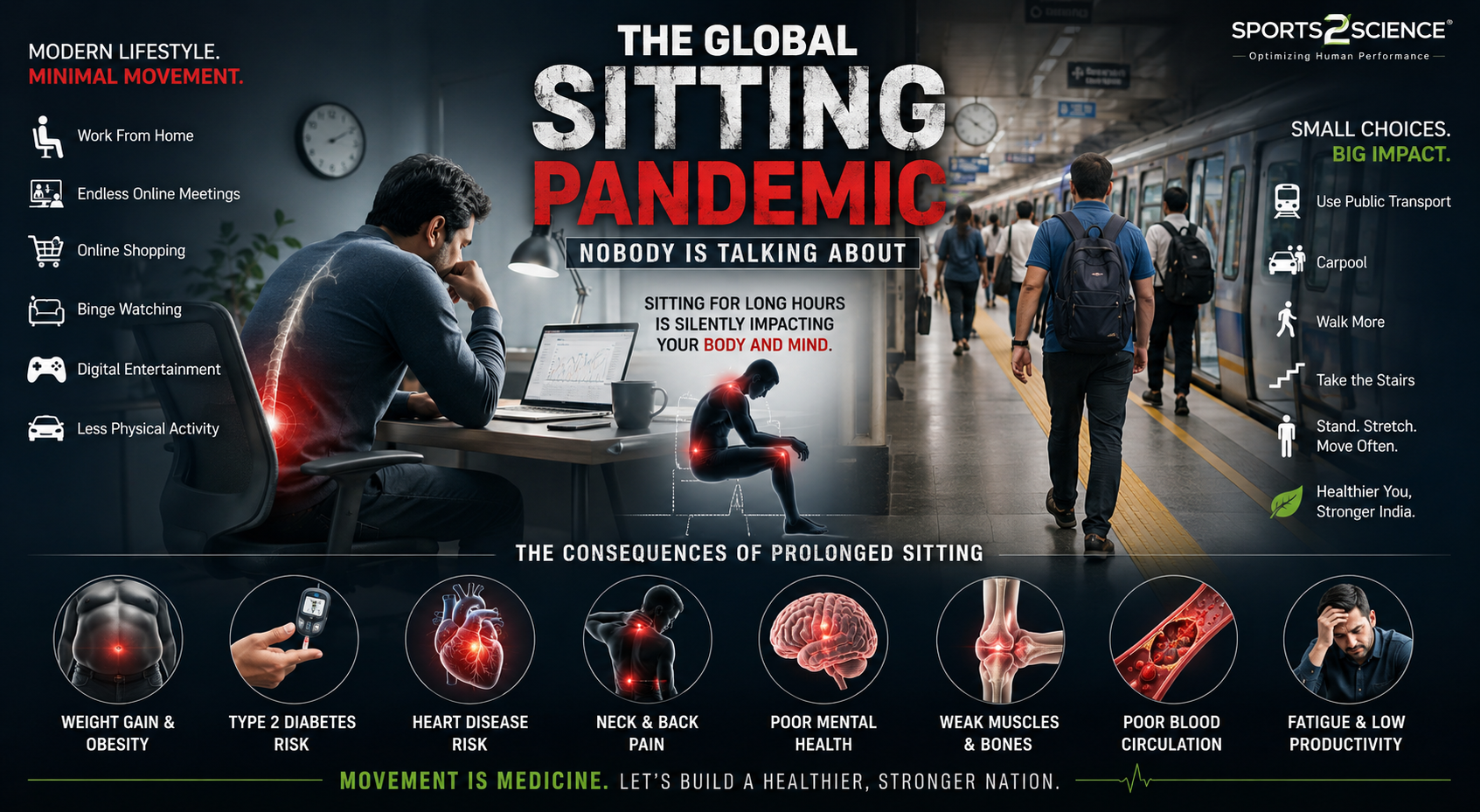
The Global Sitting Pandemic
For the first time in human history, millions of people can:
- Work
- Shop
- Eat
- Study
- Socialize
- Attend meetings
- Watch entertainment
- Travel virtually
…without physically moving.
Convenience has evolved faster than human biology.
The result?
A worldwide “sitting pandemic” affecting:
- Corporates
- Students
- Athletes
- Drivers
- IT professionals
- Children
- Gamers
- Remote workers
- Even fitness enthusiasts outside training hours
This is not just about obesity.
This is about the gradual decline of human movement intelligence.
Humans Were Never Designed for This Lifestyle
For thousands of years, the human body was shaped not inside buildings, but by the demands of the natural world. Long before chairs, screens, and artificial lighting existed, survival depended entirely on movement. Humans walked across vast landscapes in search of water, food, and safety. They carried children, tools, and harvested resources over long distances. They climbed rocks, trees, and uneven terrains not as exercise, but as necessity. Squatting was once a natural resting posture around fires and villages. Crawling was part of early development and exploration. Sprinting meant escaping danger or chasing opportunity. Even the simple act of exploring unfamiliar environments constantly challenged the body to adapt, balance, react, and grow stronger.
Every step, every climb, every rotation of the spine, every shift in posture quietly trained the human system over thousands of generations. The heart adapted to endurance. Muscles adapted to variability. Bones strengthened through loading. The brain itself evolved alongside movement, learning coordination, rhythm, spatial awareness, and survival through physical interaction with the environment.
Movement was never something humans scheduled for one hour in a gym.
Movement was life itself.
The human body was not designed for endless stillness. It was designed for unpredictability, exploration, and motion. Our ancestors did not “exercise” because movement was inseparable from existence. To be alive was to move. And perhaps that is why the modern body struggles so deeply in environments where movement has slowly disappeared from daily life.
Today, movement has become optional.
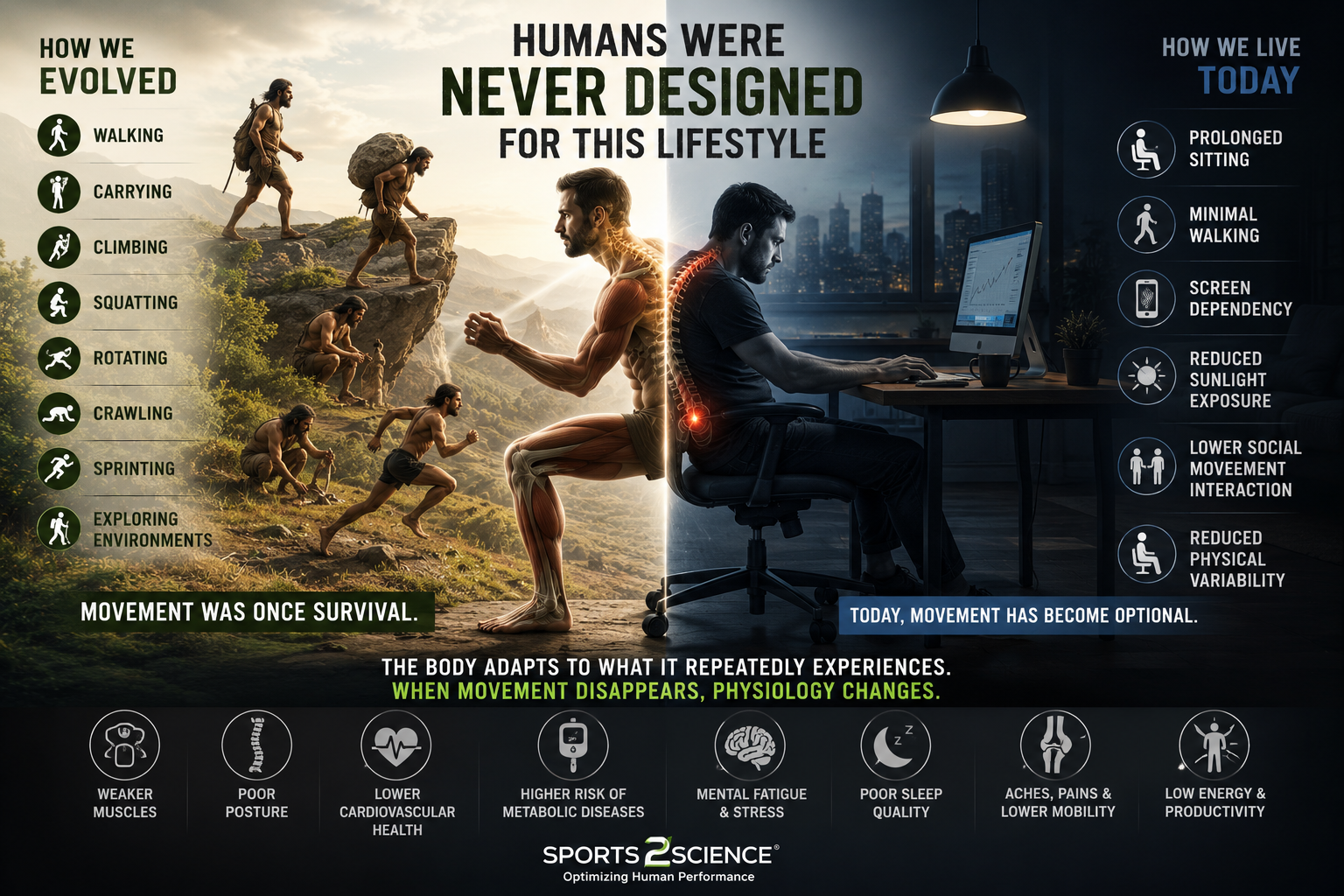
Modern life no longer demands movement the way the world once did. In fact, it quietly encourages the opposite. A person can now wake up, work, eat, shop, attend meetings, socialize, and entertain themselves without ever truly leaving a chair. The modern environment has been engineered for convenience so efficiently that physical effort is slowly disappearing from everyday existence.
At Sports2Science, this transformation is becoming increasingly visible through biomechanics, movement analysis, ergonomics assessments, and human performance observations across athletes, corporates, runners, and the general population. What was once considered “normal tiredness” is now revealing deeper patterns connected to prolonged sitting, reduced movement variability, and sedentary lifestyles.
Hours pass seated in front of glowing screens. Elevators replace stairs. Deliveries replace walking. Conversations happen through notifications instead of shared spaces. Sunlight is filtered through office windows while entire days unfold under artificial lighting. Even moments of rest have changed; recovery no longer means stepping outside or interacting with the environment, but collapsing into another screen at the end of an already motionless day.
And the human body notices all of it.
The body is constantly adapting to whatever it repeatedly experiences. It does not understand whether a lifestyle is modern, efficient, or technologically advanced. It only understands patterns. When movement decreases, the body begins reorganizing itself around inactivity. Muscles that are not used become weaker. Joints exposed to fewer movement variations become stiffer. Breathing patterns change. Circulation slows. Posture gradually collapses inward. Energy levels fluctuate. Even the nervous system begins responding differently to stress, fatigue, and recovery.
This is one of the major reasons why Sports2Science increasingly focuses not only on athlete performance, but also on human movement science, posture analysis, ergonomics, recovery, and long-term health sustainability for modern lifestyles. The same body that once adapted to movement is now adapting to stillness — and the consequences are becoming visible everywhere from corporate offices to schools, homes, and even elite sports environments.
What makes this transformation dangerous is how silent it is.
The decline rarely arrives dramatically. It happens slowly, almost invisibly, hidden inside routines people consider normal. A little stiffness while getting up from a chair. Tightness in the neck after another day on a laptop. Fatigue without physical effort. Reduced flexibility. Poor sleep despite exhaustion. The body whispers long before it screams.
For thousands of years, human physiology evolved through movement variability — walking on uneven terrain, climbing, carrying, rotating, balancing, adapting to constantly changing environments. Today, many people move through the same few positions every single day: chair, car seat, office desk, sofa, bed.
The environment has changed faster than human biology can adapt.
And when movement slowly disappears from life, physiology begins to change in ways modern society is only starting to fully understand. Through biomechanics, ergonomics, movement analysis, and human performance science, Sports2Science believes the future of health may depend not only on medicine or exercise, but on helping humans rediscover movement as a fundamental part of life again.
Work From Home: A Double-Edged Sword
Work from home was once seen as a temporary adjustment. Then it became a convenience. Today, for millions of people around the world, it has quietly become a lifestyle.
Recently, Prime Minister Narendra Modi encouraged organizations and citizens to reconsider work-from-home practices where appropriate, largely as part of broader efforts to reduce fuel dependency, traffic burden, and economic strain during uncertain global conditions. (The Economic Times)
From one perspective, the idea makes perfect sense.
Remote work has undoubtedly improved certain aspects of modern living. For many people, it reduced exhausting commutes through crowded traffic. It gave back hours once lost on the road. Parents spent more time with families. Professionals gained flexibility. Some even discovered moments of recovery and calm that traditional office culture rarely allowed.
The modern worker no longer needed to wake before sunrise just to sit inside traffic for hours.
On the surface, it felt like progress.
And in many ways, it was.
But hidden quietly beneath the convenience was another transformation that few people fully noticed while it was happening.
Human movement began disappearing from daily life.
At Sports2Science, this shift has become increasingly visible through biomechanics assessments, posture analysis, movement screening, ergonomics observations, and human performance evaluations across corporates, athletes, and general populations. The issue is no longer simply about “working from home.” The deeper issue is how modern work environments are changing the way the human body functions.
A commute once involved at least some movement — walking to vehicles, climbing stairs, moving through offices, interacting physically with environments, shifting postures throughout the day. Small movements accumulated naturally without people realizing their importance.
Work-from-home culture quietly removed many of those invisible movement exposures.
The bedroom became the office.
The dining table became the workstation.
Meetings moved into screens.
Entire days unfolded within a few square meters of space.
And slowly, the body adapted.
Not dramatically. Quietly.
A slight stiffness in the neck after long calls.
Tight hips from remaining seated.
Lower back discomfort appearing without injury.
Eye fatigue.
Reduced sunlight exposure.
Poor sleep quality despite physical inactivity.
Mental exhaustion without physical effort.
Many people today feel strangely tired after days involving almost no real movement at all.
That contradiction reveals something important:
The human body was never designed for prolonged stillness, even when the mind remains constantly active.
From a movement science perspective, work from home is a double-edged sword. It solves certain modern problems while unintentionally creating others. While technology improved efficiency, it also reduced physical variability — one of the most essential requirements for healthy human physiology.
At Sports2Science, one growing observation is that modern fatigue is no longer caused only by overwork. Increasingly, it is also linked to under-movement. The body and nervous system still expect walking, sunlight, posture variation, environmental interaction, and physical transitions throughout the day.
Without them, the human system slowly begins drifting away from the conditions it originally evolved to thrive in.
The challenge therefore is not whether work from home is “good” or “bad.”
The real challenge is understanding how humans can continue embracing technological progress without disconnecting from the biological movement patterns that have sustained human health for thousands of years.
The Hidden Cost of Sitting All Day
What makes modern sitting so dangerous is not that it feels harmful.
It is that it feels harmless.
A person can spend an entire day seated and still believe they were “busy,” “productive,” or even “resting,” while the body quietly experiences something entirely different.
In many work-from-home environments, movement slowly disappears without anyone consciously noticing it. Hours blend together inside the same position. Morning coffee turns into laptop work. Laptop work flows into meetings. Meetings continue into scrolling. Scrolling turns into streaming. Before the day ends, the body may have remained seated for eight, ten, sometimes even twelve continuous hours.
At Sports2Science, this pattern is becoming increasingly visible through biomechanics analysis, posture assessments, ergonomics evaluations, and movement screenings across corporates, athletes, students, and the general population. The body begins revealing the consequences long before people recognize the true cause.
A slight stiffness around the neck becomes frequent.
The shoulders begin tightening.
The lower back feels heavy while standing up.
Hips lose mobility.
Walking feels less natural.
Breathing becomes shallower.
Energy drops despite minimal physical effort.
Over time, even posture begins changing.
The spine gradually adapts to prolonged seated positions. The chest collapses inward. The head shifts forward. Muscles designed for movement become conditioned for stillness instead.
What is important to understand is this:
These changes are not necessarily occurring because people are weak.
They are occurring because the human body adapts extraordinarily well to whatever it repeatedly experiences.
And right now, millions of bodies are repeatedly experiencing inactivity.
Sitting Is Not Just a Posture Problem
One of the greatest misconceptions about sitting is believing it only affects muscles and joints.
In reality, prolonged inactivity reaches far deeper into human physiology.
The body functions as an interconnected system. When movement decreases, multiple systems begin changing simultaneously — often silently.
Metabolism becomes less efficient.
Blood circulation slows.
Hormonal regulation shifts.
Recovery quality decreases.
Sleep patterns become disrupted.
Brain function and mood may change.
Cardiovascular capacity gradually declines.
Even mental fatigue behaves differently in physically inactive lifestyles.
Many people today experience a strange form of exhaustion where the body barely moves, yet the mind feels continuously overloaded. The nervous system remains stimulated while the body remains still — a combination modern human biology never truly evolved for.
At Sports2Science, one of the growing observations in human performance science is that health is influenced not only by exercise, but by movement distribution across the entire day.
This is where the concept of NEAT becomes incredibly important:
Non-Exercise Activity Thermogenesis
It refers to the small movements humans naturally performed throughout life:
walking,
standing,
changing posture,
climbing stairs,
moving between spaces,
adjusting positions,
interacting physically with environments.
Historically, humans accumulated these movements unconsciously.
Today, modern lifestyles have dramatically reduced them.
And the body notices the difference.
A person may still exercise for one hour in the gym, complete a run, or attend a fitness class. But if the remaining ten or twelve hours are spent sitting continuously, the physiological effects of prolonged inactivity still remain significant.
The human body does not only respond to workouts.
It responds to repeated daily behavior.
That is why movement throughout the day matters far more than most people realize.
The future of health may not depend only on how intensely humans exercise.
It may depend on whether humans continue moving at all between the moments they exercise.
Public Transport May Be More Important Than We Think
One of the most overlooked aspects of Prime Minister Narendra Modi’s recent message was not only about saving fuel or reducing economic strain. Hidden within the discussion was something much deeper — a subtle reminder about movement itself.
The encouragement to use metro systems, public transportation, and carpooling was largely viewed through the lens of sustainability and energy conservation. (The Economic Times)
But from the perspective of biomechanics, human performance, and movement science, the implications may be far more profound.
At Sports2Science, one growing observation is that modern health is not influenced only by intense exercise sessions. It is increasingly shaped by the small movements people either gain or lose throughout everyday life.
Public transport quietly reintroduces movement into daily living.
A person walking toward a metro station may unknowingly accumulate hundreds or thousands of additional steps. They climb stairs instead of pressing elevator buttons. They stand during travel rather than remaining continuously seated. Their body constantly performs subtle balance adjustments as trains move, stop, and shift direction. Even navigating through crowded environments stimulates coordination, posture changes, spatial awareness, and nervous system responsiveness.
These movements appear insignificant in isolation.
But human physiology has always adapted through repetition.
Small daily movement exposures repeated for years can create enormous long-term differences in cardiovascular health, mobility, metabolic function, posture, and overall human performance.
Ironically, many modern lifestyles have eliminated precisely these invisible movement opportunities.
Private vehicles now transport people almost door-to-door. Elevators replace staircases. Deliveries replace walking. Screens replace environmental interaction. Human beings increasingly move through life with minimal physical engagement with the world around them.
And the body slowly adapts accordingly.
Perhaps the future of public health will not depend only on hospitals or medications, but also on whether cities continue creating environments where movement naturally remains part of everyday life.
The Psychological Side Nobody Discusses
The sitting pandemic is often discussed as a physical health problem.
But the effects of reduced movement reach far deeper than muscles and joints.
The human nervous system evolved alongside physical interaction with the environment. For thousands of years, movement stimulated attention, awareness, emotional regulation, social behavior, and cognitive adaptability. Human beings were not only physically active creatures — they were neurologically shaped by movement itself.
Today, however, millions of people spend most of their waking hours inside highly controlled environments:
screens,
offices,
vehicles,
rooms,
notifications,
virtual conversations.
And something psychological begins to change when physical interaction with the real world decreases.
During the pandemic era, many individuals described experiences that felt strangely similar despite living completely different lives:
brain fog,
mental fatigue,
reduced motivation,
difficulty concentrating,
social exhaustion,
emotional numbness.
Many people felt tired despite barely moving physically.
That contradiction matters.
At Sports2Science, movement science increasingly reveals that the human brain and nervous system still expect variability — walking outdoors, changing environments, sunlight exposure, posture transitions, physical exploration, and social interaction beyond screens.
Movement is not merely exercise for the body.
It is stimulation for the brain.
Walking regulates thought.
Environmental interaction sharpens awareness.
Physical movement influences mood, stress regulation, and emotional resilience in ways modern sedentary environments cannot fully replicate.
The modern world successfully connected humans digitally.
But in many ways, it disconnected humans biologically from the environments they evolved within.
Children May Be the Most Vulnerable
Perhaps the greatest concern of all is not what inactivity is doing to adults.
It is what modern sedentary living may be doing to children.
For the first time in human history, entire childhoods are unfolding through screens.
Tablets entertain.
Phones educate.
Streaming platforms replace outdoor play.
Gaming environments replace physical exploration.
Social interaction increasingly happens digitally instead of physically.
At first glance, this appears normal because technology has become deeply integrated into modern life.
But the human body has not evolved at the same speed as technology.
Childhood was once filled with natural movement variability:
running,
climbing,
balancing,
jumping,
falling,
crawling,
exploring unfamiliar spaces.
These were not merely games.
They were developmental experiences shaping coordination, posture, bone strength, nervous system adaptability, movement confidence, and cognitive growth.
At Sports2Science, one increasingly important concern in biomechanics and human performance science is whether modern environments are reducing the movement exposure required for healthy long-term development.
The consequences may not appear immediately.
But over time, reduced movement variability may contribute to:
poor posture development,
lower athleticism,
reduced coordination,
decreased mobility,
higher obesity risk,
lower confidence in physical environments.
This is not about rejecting technology.
Technology is extraordinary.
The real challenge is ensuring that technological advancement does not unintentionally remove the movement experiences human biology still fundamentally depends on.
Athletes Are Also Affected
Many people assume elite athletes are protected from sedentary lifestyles simply because they train intensely.
But modern movement science tells a different story.
At Sports2Science, biomechanics assessments and athlete monitoring increasingly reveal that performance limitations are no longer influenced only by training itself. They are also shaped by the lifestyle patterns surrounding training.
An athlete may practice for two or three hours daily.
But what happens during the remaining twenty-one hours still matters enormously.
Hours spent sitting,
screen-heavy recovery habits,
poor sleep routines,
reduced mobility outside training,
limited sunlight exposure,
and prolonged inactivity between sessions can all influence recovery, nervous system regulation, movement efficiency, and long-term performance sustainability.
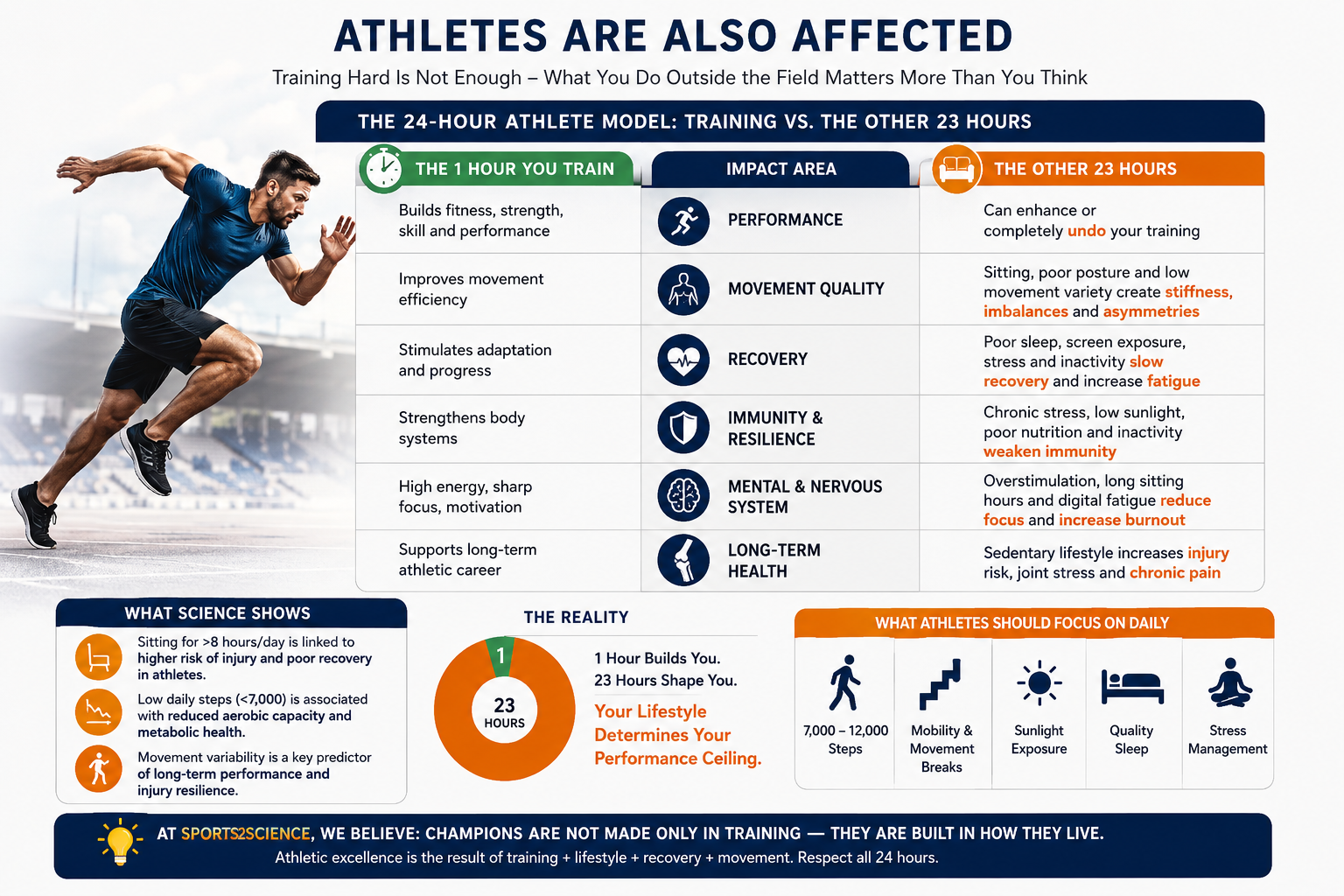
The human body responds to total daily behavior — not only scheduled workouts.
This is why some athletes today experience:
movement asymmetries,
hip stiffness,
mobility limitations,
recovery inefficiencies,
nervous system fatigue,
and chronic tightness despite high training volumes.
The issue is not necessarily lack of effort.
Sometimes the issue is lack of movement variability outside structured training itself.
One hour of intense training cannot fully compensate for an entire day of inactivity.
Performance is influenced by the other twenty-three hours too.
The Future Health Crisis May Not Be Infectious — It May Be Behavioral
Modern healthcare systems across the world are already witnessing dramatic rises in:
obesity,
diabetes,
metabolic disorders,
cardiovascular disease,
musculoskeletal pain,
burnout,
postural dysfunction,
and sedentary lifestyle-related conditions.
What makes these problems particularly dangerous is how silently they develop.
The body rarely fails overnight.
Instead, it adapts gradually.
A little less mobility.
A little more fatigue.
A little more stiffness.
Reduced cardiovascular capacity.
Lower energy.
Poorer recovery.
The symptoms accumulate slowly until dysfunction eventually becomes impossible to ignore.
At Sports2Science, one growing realization within biomechanics, ergonomics, and human performance science is that many modern health problems are no longer caused purely by trauma or disease alone.
Increasingly, they are influenced by chronic behavioral inactivity.
The greatest health crisis of the future may not spread through infection.
It may spread through lifestyles that gradually disconnect human beings from movement itself.
The Solution Is Not “More Exercise”
This is perhaps the most important realization of all.
The solution to the sitting pandemic is not simply telling people to “exercise more.”
Exercise is important. Deeply important.
But the future of human health may depend even more on whether movement becomes naturally reintegrated into everyday life again.
At Sports2Science, the conversation increasingly extends beyond gyms and athletes into broader questions about how modern environments influence long-term human biology.
Future health may depend on:
walkable cities,
ergonomic workplaces,
movement-friendly education systems,
standing variability,
sunlight exposure,
active transportation,
public infrastructure,
and workplaces designed around human physiology rather than endless sitting.
Modern civilization optimized convenience extraordinarily well.
Now it must learn to optimize human sustainability too.
Because humans were not designed merely to remain productive.
Humans were designed to move.
India Has a Unique Opportunity
India is currently standing at a fascinating crossroads.
Rapid urbanization, digital growth, remote work transformation, AI integration, infrastructure development, and technological expansion are reshaping how millions of people live every single day.
But this transformation also creates a rare opportunity.
India still has the ability to build future systems differently.
At Sports2Science, one belief continues becoming clearer:
The future of healthcare may increasingly depend on preventive human performance science rather than reactive disease management.
If movement science, ergonomics, biomechanics, public health, and human-centered urban design are integrated early into modern systems, India could become a global leader in sustainable human health rather than simply treating lifestyle diseases after they emerge.
The national conversation should not only ask:
“How do we modernize society?”
It should also ask:
“How do humans remain biologically healthy while modernizing?”
That question may define the health of future generations.
The Bigger Question
Technology is advancing faster than ever before.
Artificial intelligence is evolving.
Automation is increasing.
Convenience continues expanding into every corner of life.
But beneath all of this progress remains one uncomfortable question:
Are human beings adapting biologically at the same speed as their environments?
Modern civilization optimized comfort, speed, efficiency, and convenience.
But the human body still carries ancient biological expectations.
It still expects sunlight.
It still expects movement.
It still expects physical interaction with the world.
It still expects variability, walking, climbing, standing, balancing, and exploration.
And when those disappear, something inside human physiology slowly begins to change.
Quietly. Gradually. Almost invisibly.
Perhaps the real pandemic of modern civilization is not viral at all.
Perhaps it is behavioral inactivity.
And perhaps the future of human health will depend on whether society remembers something ancient that the body never forgot:
Movement is not optional for human beings.
Movement is part of what makes us human.
About Sports2Science
Sports2Science is a human performance and movement science company based in Chennai working across:
- Biomechanics
- Athlete performance
- Movement analysis
- Corporate wellness
- Ergonomics
- Recovery science
- Human performance optimization
From elite athletes to corporates and the general population, the goal is simple:
Help humans move better, perform better, and live healthier for the long term.
sitting pandemic | work from home health effects | sedentary lifestyle India | biomechanics Chennai | sports science India | movement science | posture problems work from home | metabolic disease sitting | ergonomics India | public transport health benefits | Sports2Science Chennai | human performance science | corporate wellness India | sitting disease | remote work health risks
References
PM Modi’s appeals regarding work-from-home, public transport, fuel conservation, carpooling, and lifestyle changes were reported across multiple national publications. (The Economic Times)